
How Digital SOPs Transform Training Effectiveness?
November 17, 2025
Traditional training systems in manufacturing struggle to keep pace with operational complexity and rapid change. They often create the illusion of readiness without ensuring true behavioral reliability on the floor.
In most plants, training completion rises, but First-Pass Adherence and method consistency lag behind. Operators forget critical steps, rely on tribal knowledge, or re-learn processes differently across shifts. This disconnect between training and execution drives quality escapes, rework, and avoidable downtime.
Digital SOPs close this gap by transforming training into a connected, real-time, and verifiable management system—one that links knowledge, execution, and KPI stability across every shift, every line, and every operator.
Where Do Traditional Training Systems Break Down in High-Complexity Operations?
Traditional training breaks down because it relies on memory, manual updates, and inconsistent supervision—none of which can keep pace with modern manufacturing complexity.
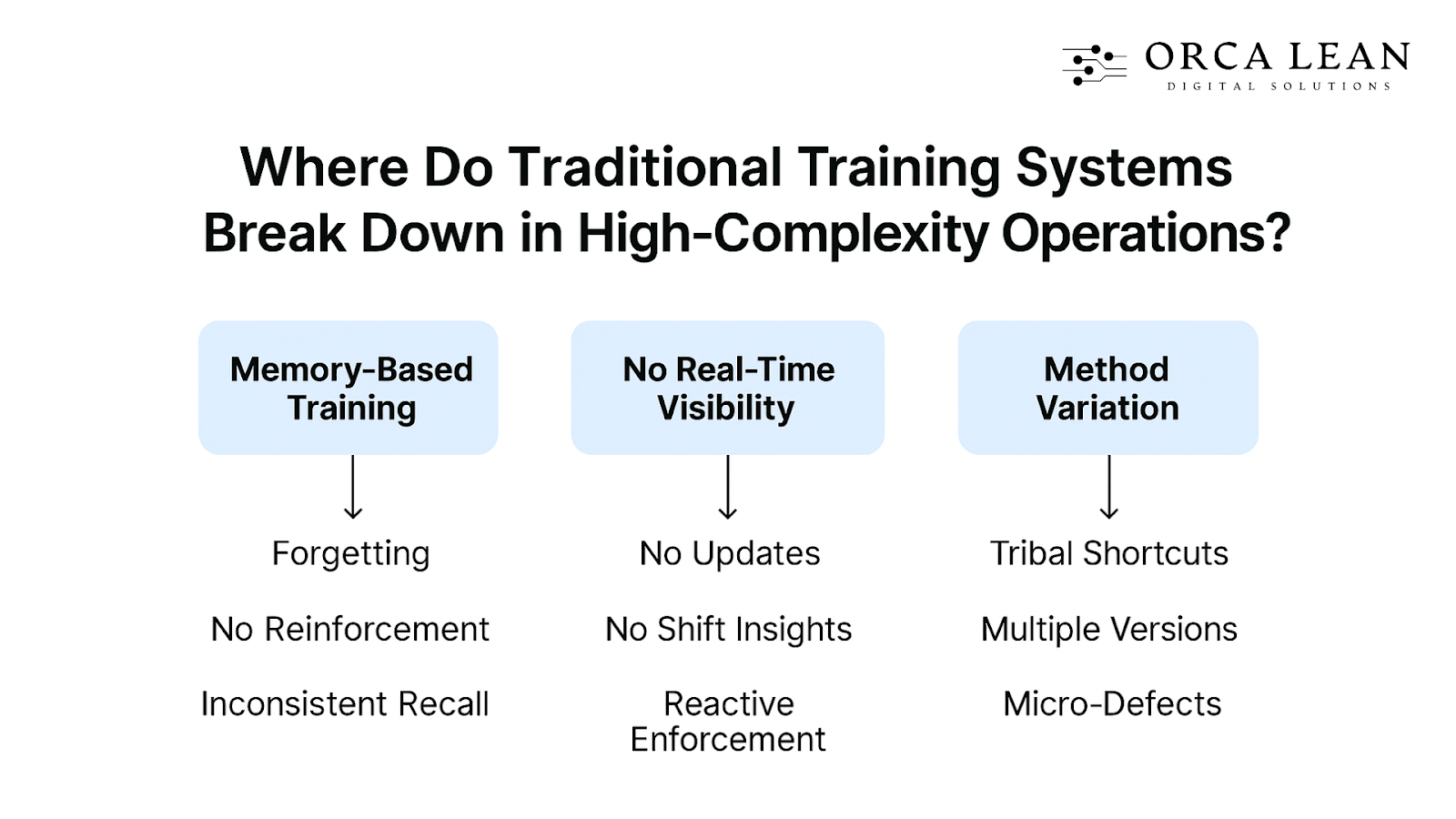
Training completion does not translate into on-floor performance
Training focuses on exposure, not retention. Operators often forget critical steps within days, especially when tasks are complex or rarely performed. Without visual cues or real-time reference, they rely on partial recall or coworker instructions, creating variation and reducing First-Pass Adherence.
- High cognitive load
- No reinforcement cycle
- Memory-driven errors
Frontline leaders lack real-time visibility to enforce adherence
Supervisors cannot enforce standards when they don’t know who is trained, who missed updates, or which steps operators are skipping. Without traceability, leaders react to defects instead of preventing them, causing recurring variation across shifts and lines.
- No update tracking
- No line/shift insights
- Enforcement relies on observation
Method variation slowly erodes FPY and FTQ
Small deviations compound into systemic quality issues. Different interpretations of the same SOP create micro-errors that go unnoticed but repeatedly impact FPY, FTQ, and customer quality. Hidden variation becomes a long-term drain on stability and performance.
- Tribal shortcuts
- Multi-version execution
- Recurring micro-defects
How does method variation quietly erode FPY and FTQ?
When operators interpret steps differently, small deviations multiply. Over time, minor variations become systemic quality issues that escape notice until KPIs decline.
Manufacturing systems depend on repeatability. But when shifts follow different interpretations of the same SOP, inconsistencies accumulate. This leads to recurring defects, rework loops, and unstable quality performance. Because these errors happen at micro-step level, they often remain invisible until FPY, FTQ, and customer complaints reveal deeper process instability.
- Different “versions” of the same task
- Tribal knowledge overrides SOPs
- Deviations become recurring problems
How Do Digital SOPs Create a Closed-Loop Training-to-Adherence System?
Digital SOPs transform training from static knowledge into a real-time, reinforced execution system that stabilizes behavior across shifts, variants, and complexity.
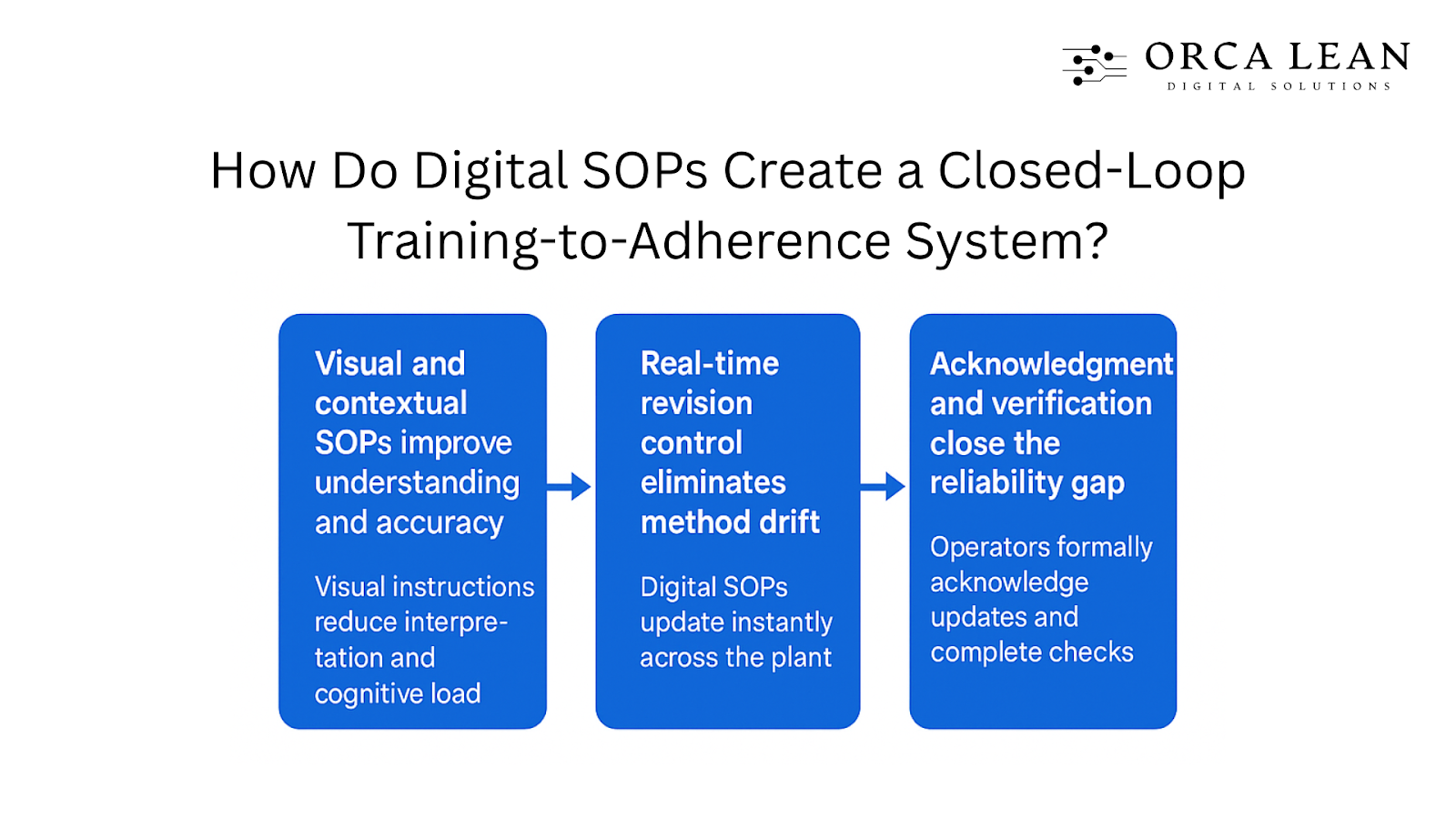
Visual and contextual SOPs improve understanding and accuracy
Visual instructions reduce interpretation and cognitive load by showing precise execution steps. Images, videos, and annotations make complex tasks simple, accelerating learning and decreasing errors across changeovers, inspections, and precision processes.
Real-time revision control eliminates method drift
Digital SOPs update instantly across the plant, ensuring every operator sees the latest approved method. Old versions are automatically blocked, preventing outdated practices and eliminating multi-version confusion across shifts.
Acknowledgment and verification close the reliability gap
Operators formally acknowledge updates and complete quick assessments or practical checks. Leaders gain verifiable evidence of understanding, ensuring updated standards actually translate into updated behaviors on the floor.
How Do Digital SOPs Directly Lift Training Compliance %?
Digital SOPs turn training compliance into a predictable, automated system rather than a manual, supervisor-driven chase for signatures and completions.
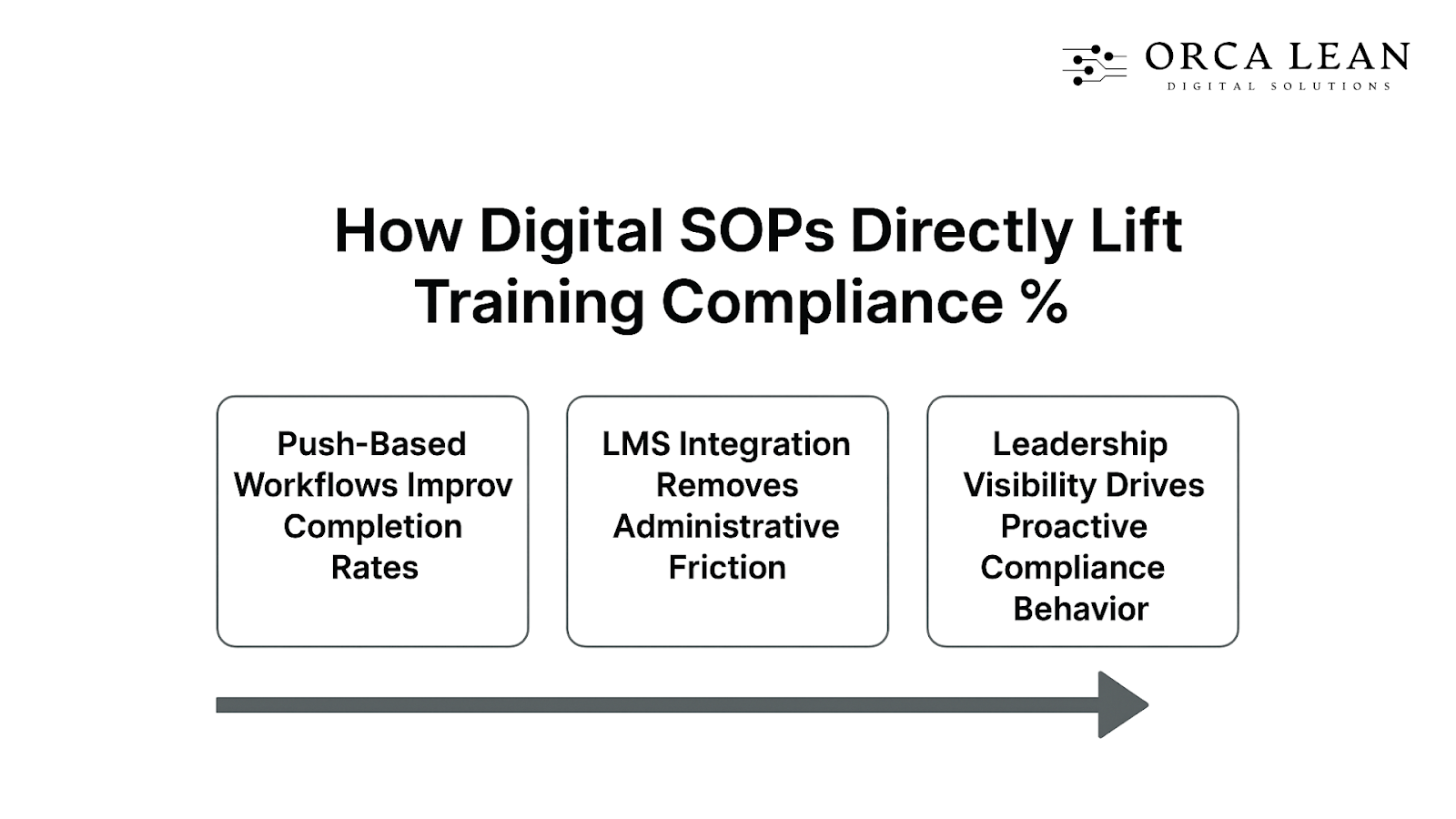
Push-based training workflows improve completion rates
Training is automatically assigned when SOPs change or new competencies are needed. Operators receive reminders and escalations without supervisor involvement. This structured automation significantly increases completion rates and eliminates delays across shifts.
LMS integration removes administrative friction
Integrating SOP platforms with LMS ensures job roles, skill matrices, and training requirements sync instantly. This prevents mismatched training, improves audit readiness, and maintains accurate records across all departments.
Leadership visibility drives proactive compliance behavior
Dashboards display overdue tasks, risk zones, and completion trends. Leaders gain clear visibility, which drives accountability, timely follow-up, and proactive compliance rather than last-minute firefighting.
Conclusion
Traditional training systems were never designed for the speed, variability, and complexity of modern manufacturing. Plants can no longer afford training models that rely on memory, manual updates, or sporadic supervision. The result is predictable—variation grows, First-Pass Adherence declines, and operational discipline erodes one shift at a time.
Digital SOPs change the equation. They transform training from a static event into a dynamic, reinforced, auditable execution system. Operators gain clarity. Leaders gain visibility. Processes gain stability. And KPIs—Training Compliance, First-Pass Adherence, FPY, FTQ—finally begin to behave the way they should.
In high-performance plants, standard work is not what’s written. It’s what’s followed. Digital SOPs make that possible.

Software Solutions for Manufacturing Excellence
Company
Social
Our Contact Info:
Email: contact@orcalean.com
Phone Number: 248 938 0375
Our Offices